
22+ Stunning Stone Bathroom Decor Ideas that Feel Spa-Quality in 2026

I’ll be honest with you – I fell hard for stone in bathrooms about eight years ago, and then I spent the next eight years learning which stones actually survive a room that gets soaked twice a day. Marble etches, limestone drinks water like a sponge, and slate will happily outlive us all. So this list is the version I wish someone had handed me: 22 stone bathroom ideas I’ve actually specified, installed, or talked a client out of, with the real maintenance truth attached to each one.
Stone Bathroom Decor Ideas
1. Full-Height Honed Marble Slab Shower Walls
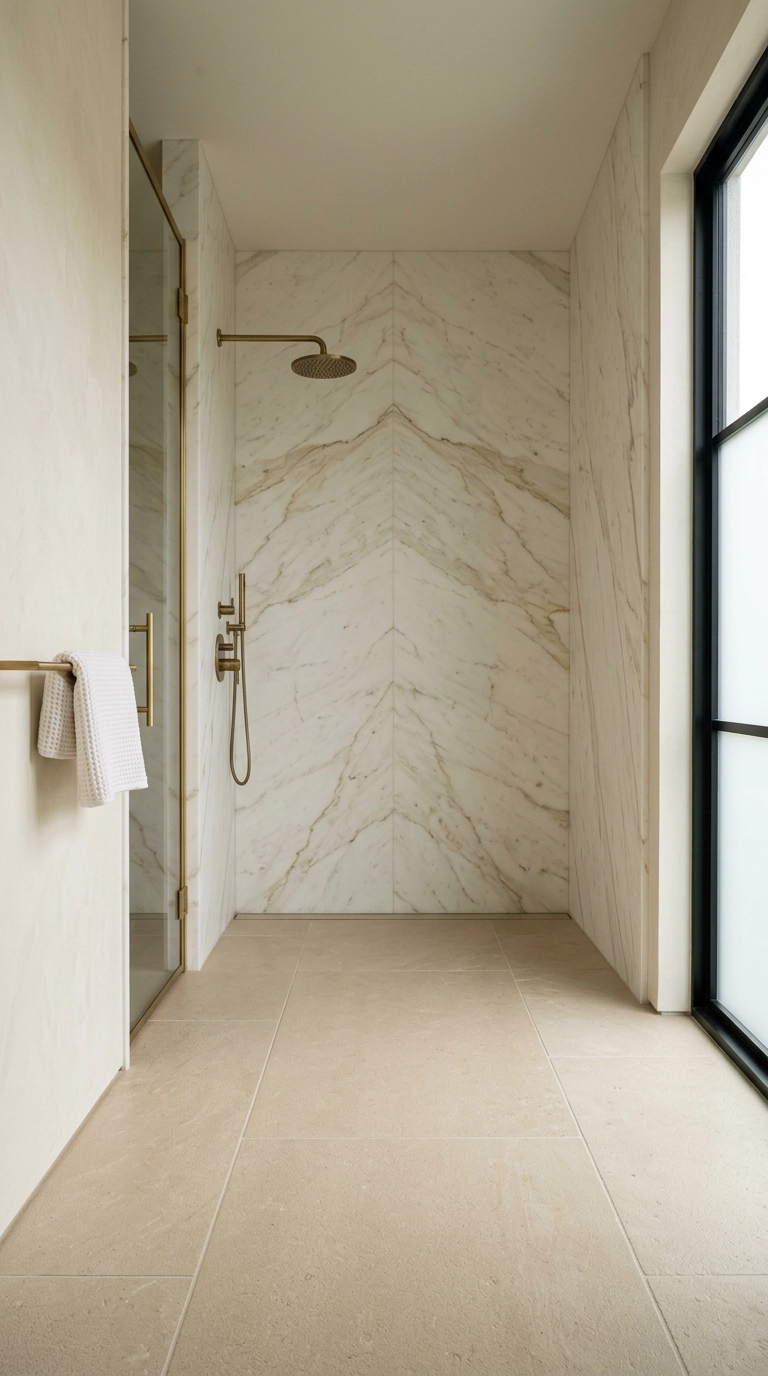
Nothing else in a bathroom reads as expensive the way a single continuous slab of marble does, because you’ve eliminated grout lines and the eye has nothing to interrupt it. Honed, not polished – honed marble has a matte, slightly velvety finish that hides water spots and etching far better, and it isn’t a skating rink underfoot.
2. Travertine Vanity Top with a Wall-Mounted Faucet
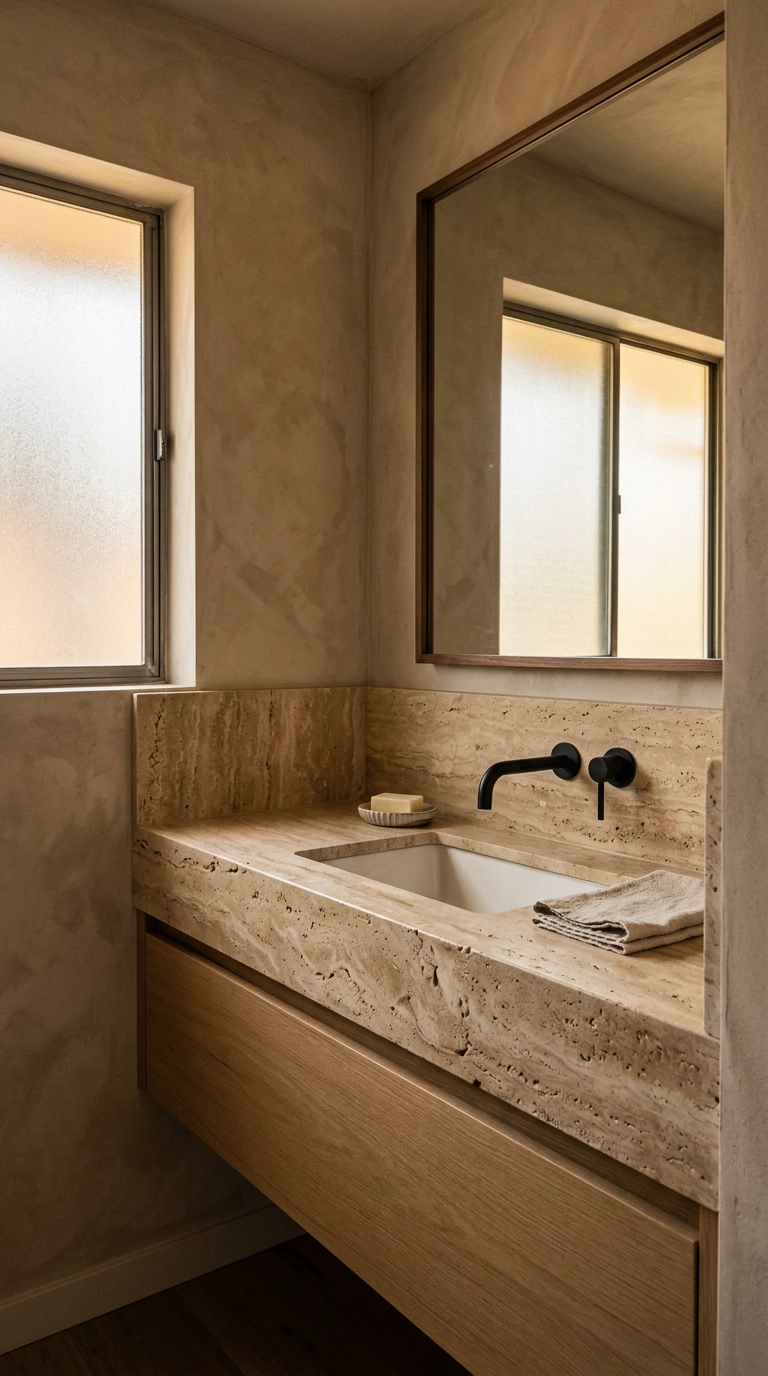
Travertine is having a full-blown revival, and vein-cut slabs – sliced against the grain so you get linear striping instead of swirls – are the ones that look current rather than 2003 Tuscan. Mounting the faucet on the wall instead of the deck keeps the whole stone surface visible, which is the entire point of paying for pretty stone.
3. Pebble Stone Shower Floor Under a Curbless Entry
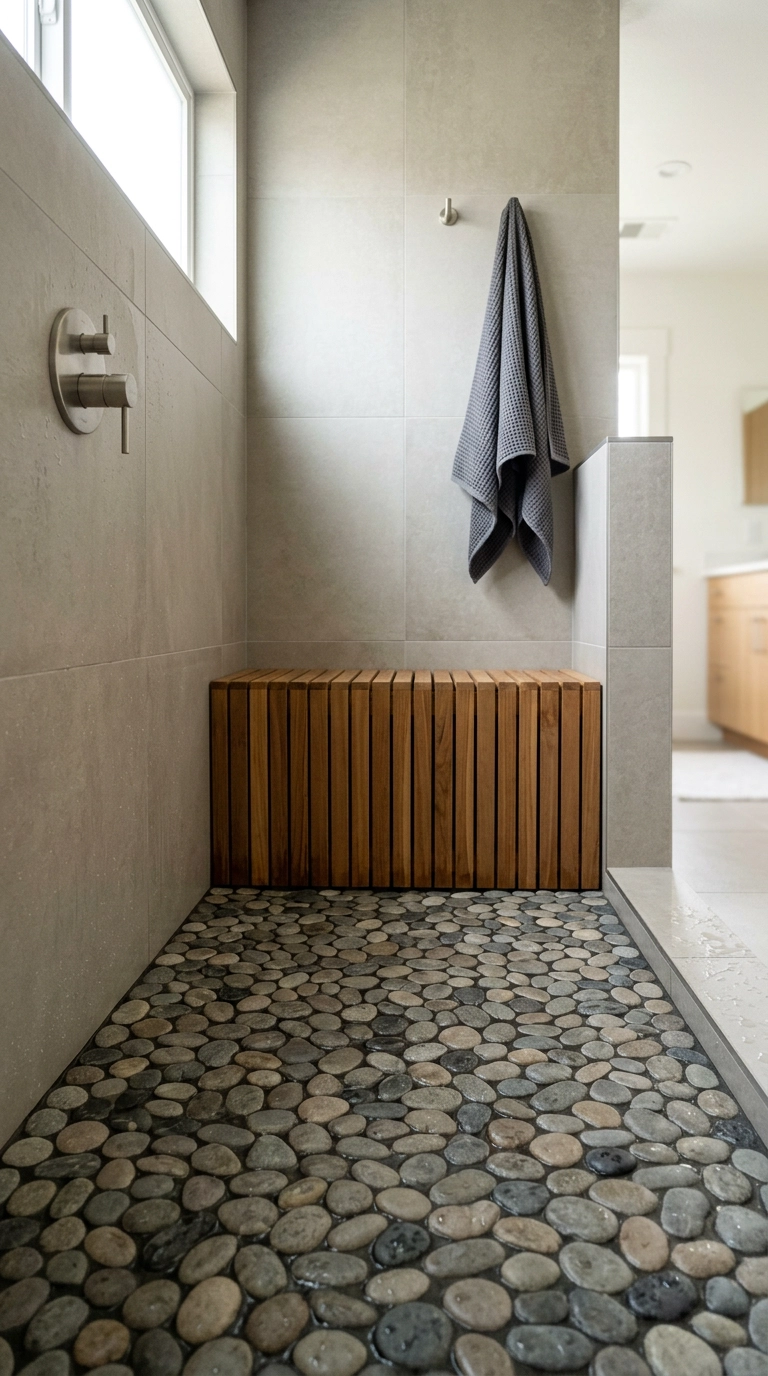
A pebble floor gives you two real advantages: it’s the grippiest surface you can put in a shower, and all those small stones let you slope the floor to a drain without ugly tile cuts. It also feels genuinely good underfoot, which is the closest a bathroom gets to a free luxury.
4. Soapstone Countertop for the Person Who Hates Babysitting Stone
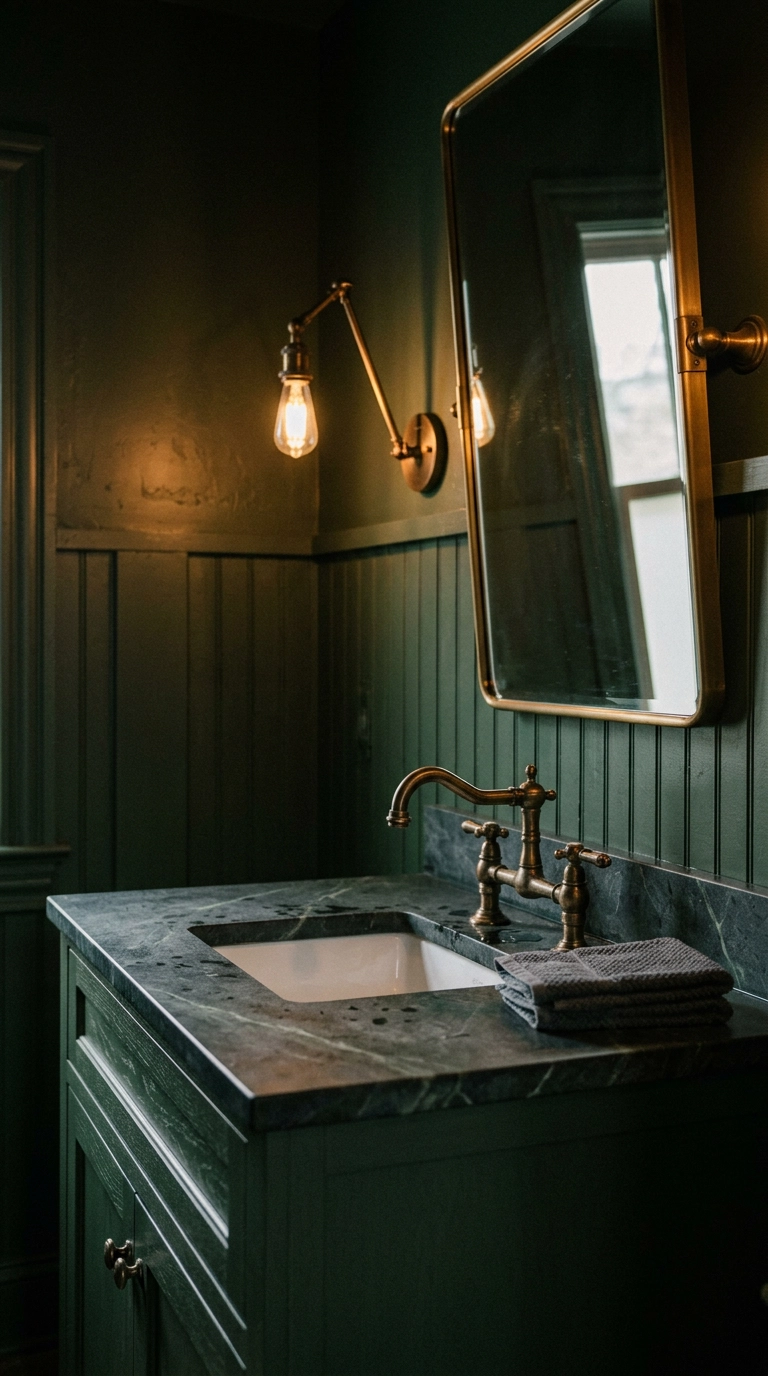
Soapstone is the low-drama stone nobody talks about enough. It’s non-porous, so acid does nothing to it – no etching, no staining from toothpaste or perfume – which makes it the most forgiving natural stone you can put in a bathroom.
5. Stone-Look Porcelain Tile: The Budget Alternative That Actually Fools People
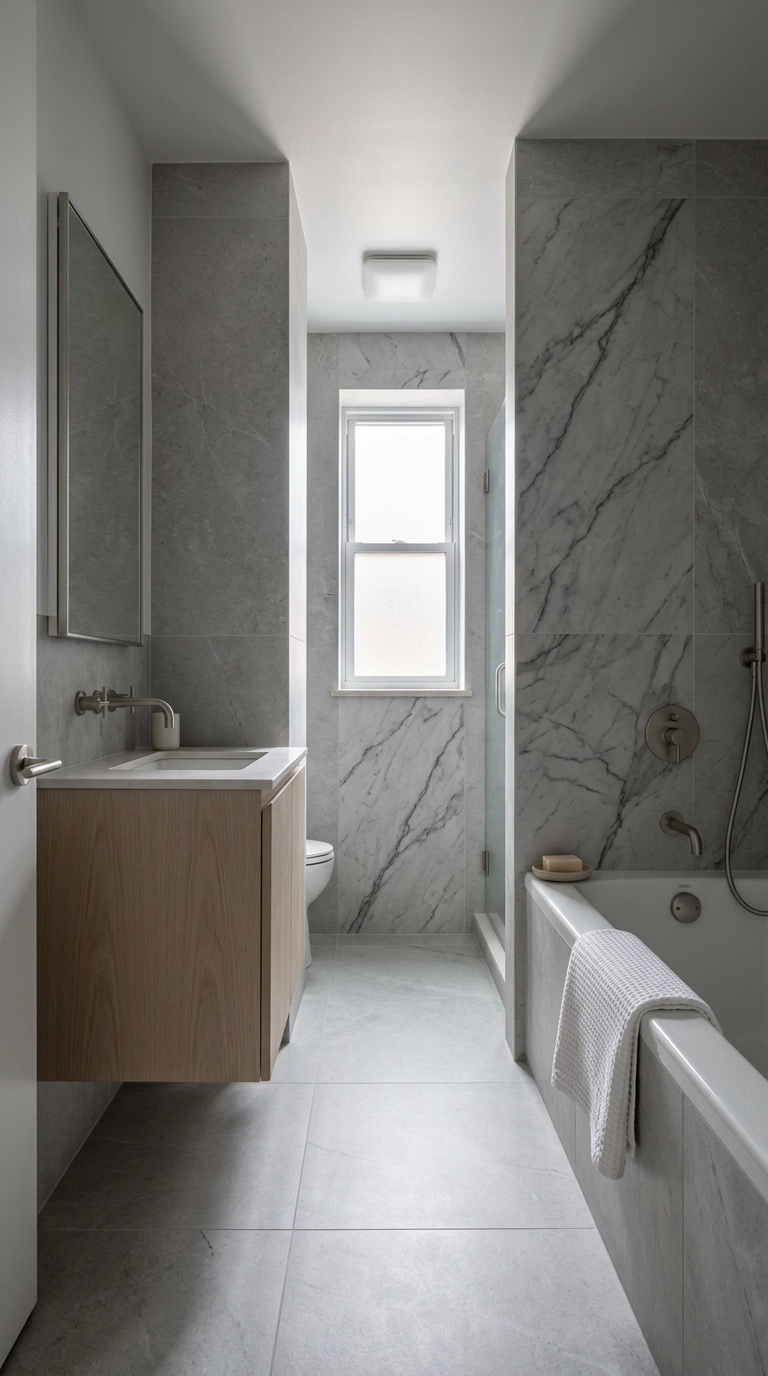
I specify stone-look porcelain constantly and I’m not apologetic about it. Modern inkjet printing on large-format slabs is genuinely convincing, it never etches, never needs sealing, and it costs a fraction of real stone – often a third or less.
6. Limestone Floor Tile in a Warm Sand Tone
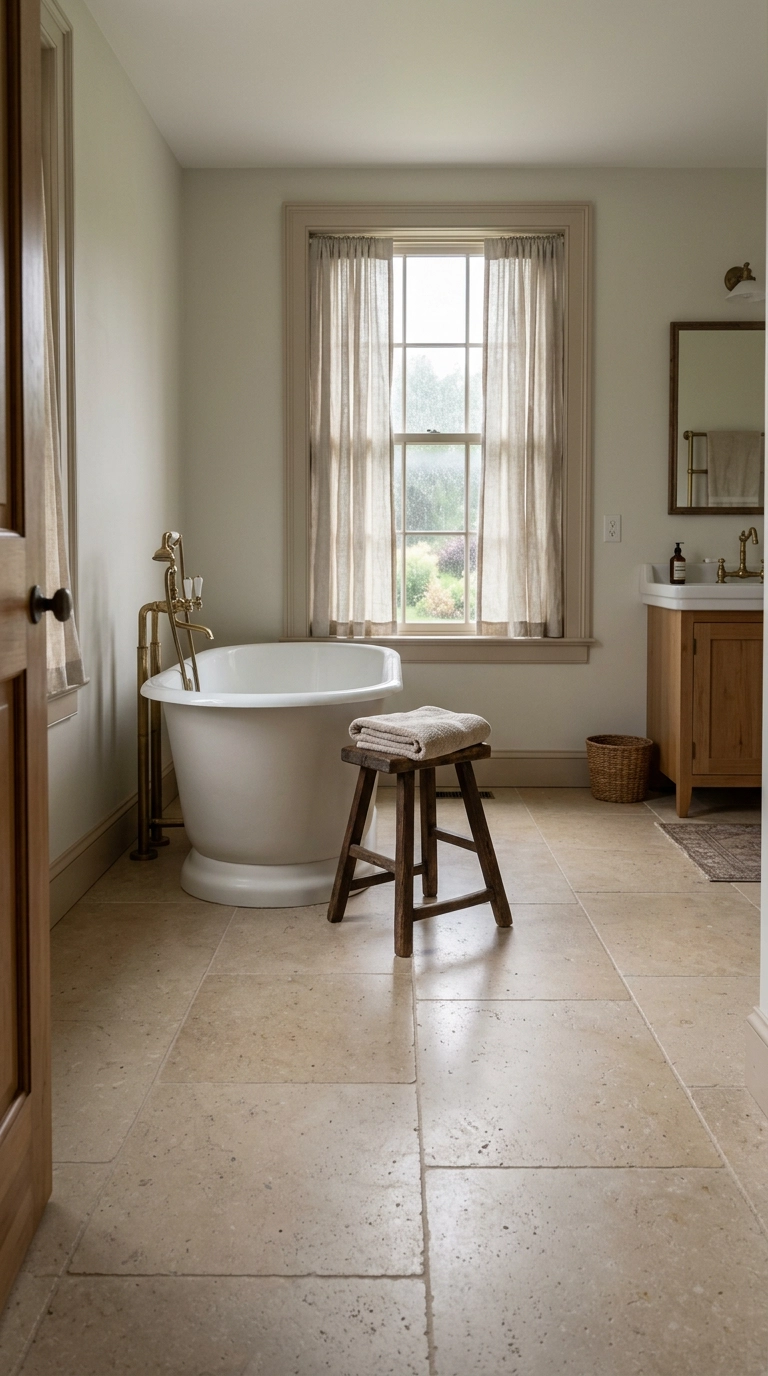
Limestone gives you the softest, warmest stone floor there is – it has a chalky matte quality that marble can’t do, and it feels less clinical in a room full of white porcelain. In a north-facing bathroom that light-starved sand tone is the difference between calm and cold.
7. A Carved Stone Vessel Sink as the Room’s Only Sculpture
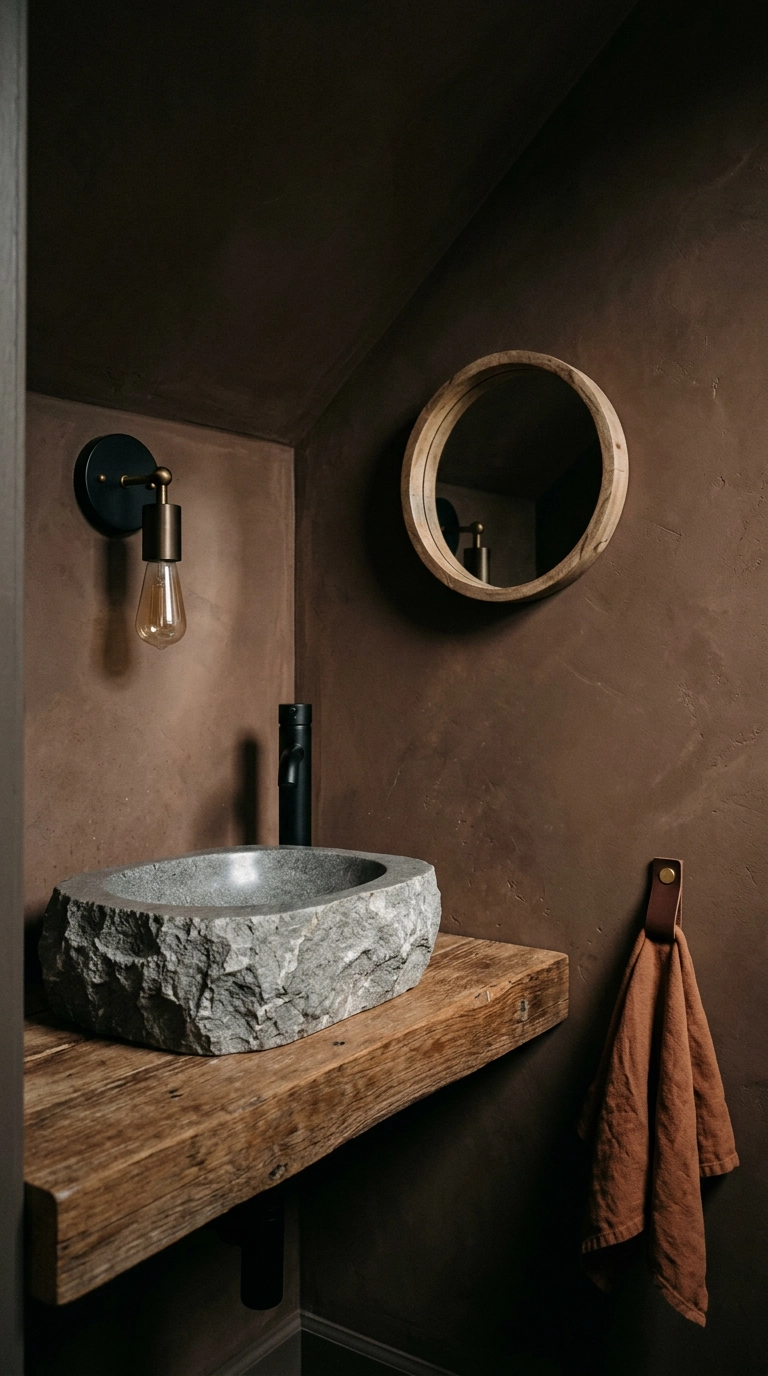
A stone vessel sink is the single highest-impact stone purchase you can make, because it’s a sculptural object sitting at eye level rather than a surface you look down at. Basalt, granite, and river stone versions all hold up fine to daily water; softer marble vessels stain around the drain faster than you’d hope.
8. Slate Floor Tile: The Stone That Genuinely Does Not Care
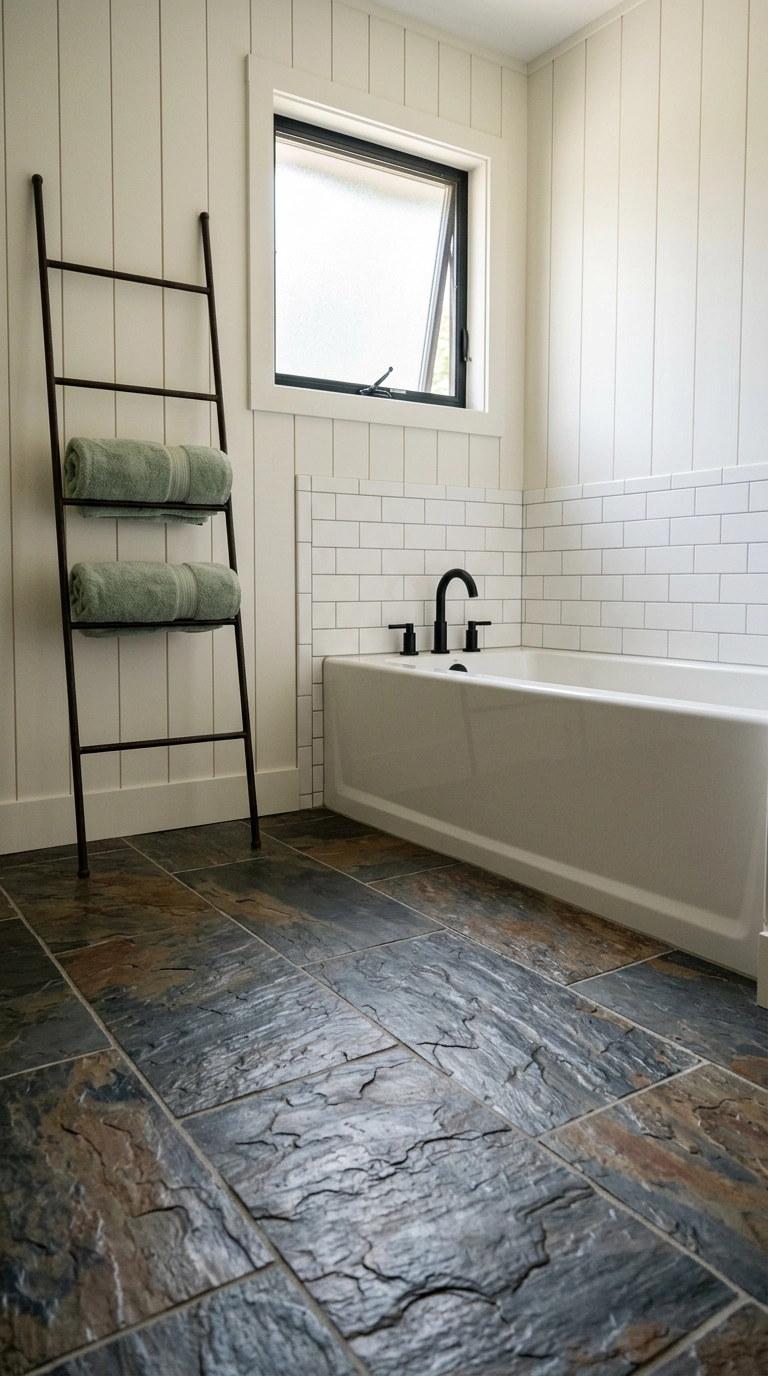
If you want one stone that will survive a wet bathroom, kids, and a decade of neglect, it’s slate. It’s dense, naturally slip-resistant thanks to its cleft surface, and dark enough that it hides everything a light stone advertises.
9. Polished Marble Accent Wall Behind the Vanity Only
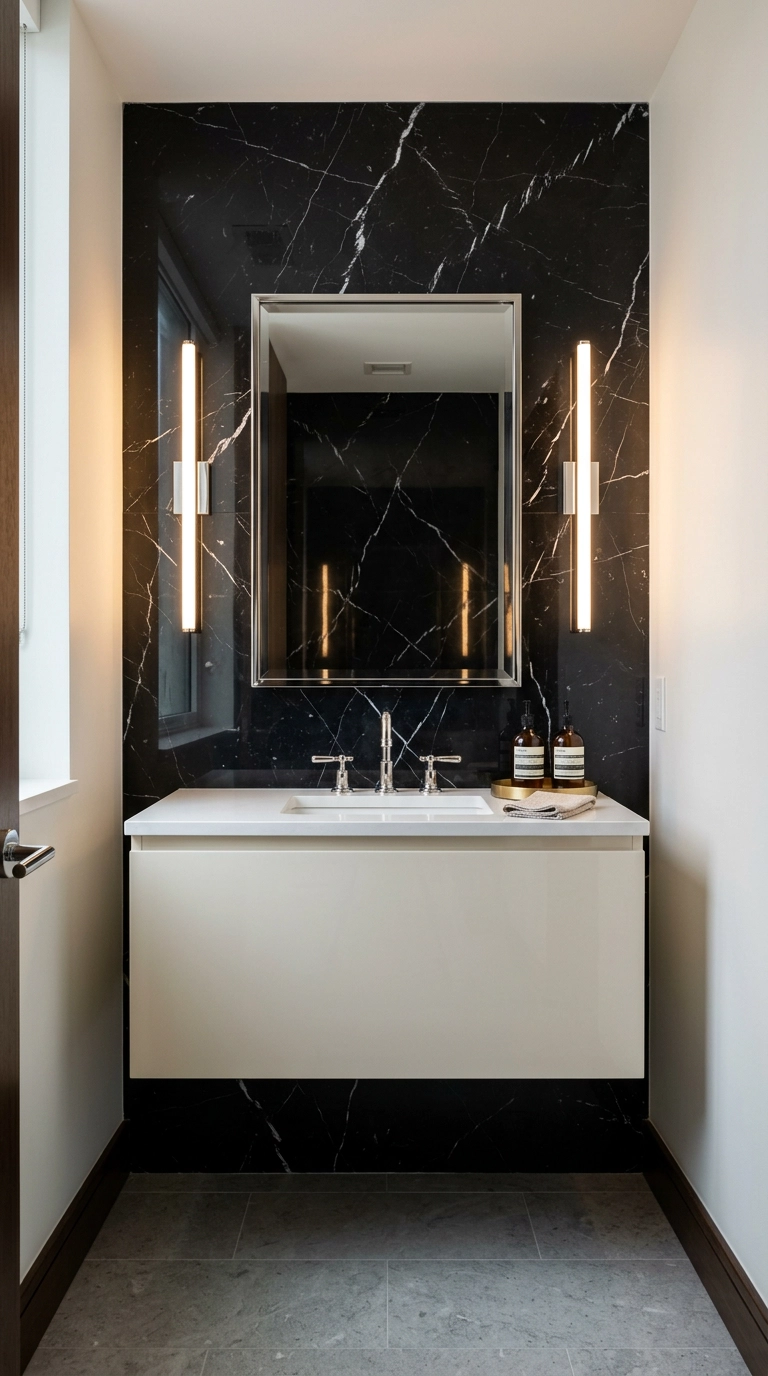
Polished marble is a nightmare on a countertop and gorgeous on a vertical surface, because walls don’t get lemon juice and perfume spilled on them. Confining a dramatic stone to one wall also means you can afford a knockout slab – a remnant piece often covers a vanity wall for a few hundred dollars.
10. Stacked Stone Ledger Panels on a Tub Surround
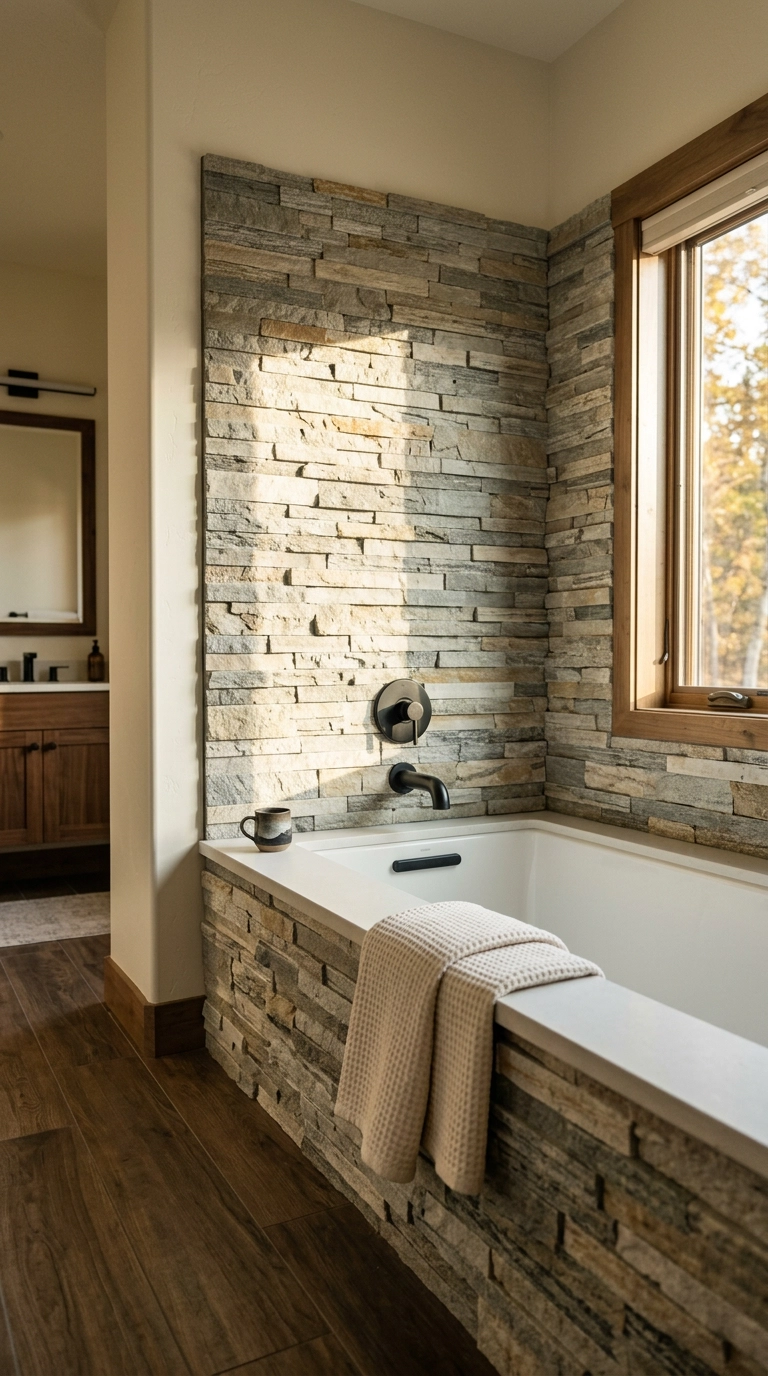
Ledger panels are thin strips of natural stone pre-mounted on mesh sheets, which means you get the look of a dry-stacked stone wall without a mason. On a tub front or a single feature wall they read as texture rather than theme, and side light makes them look twice as expensive as they are.
11. A Marble Threshold and Curb Swap You Can Do in an Afternoon
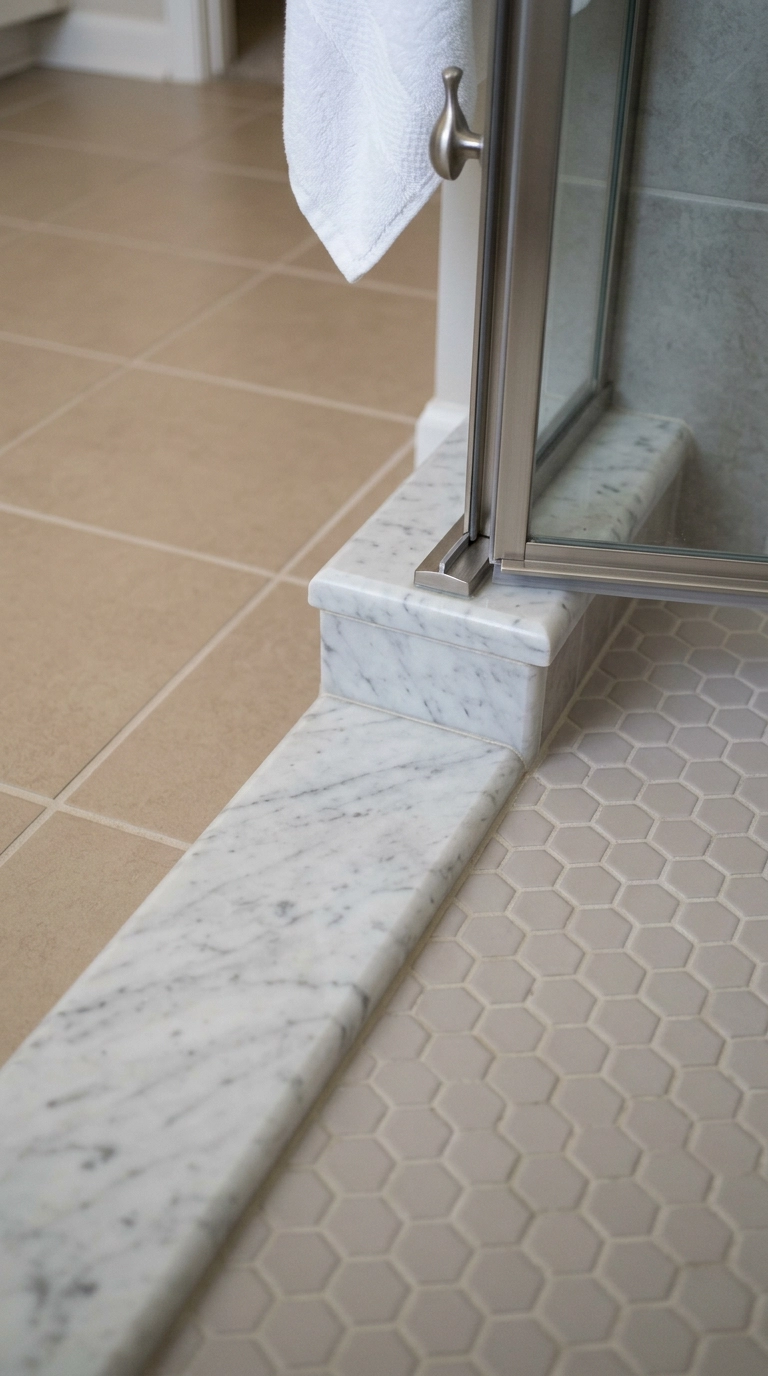
This is the cheapest real-stone upgrade in the entire article. Swapping a chipped builder threshold or a tiled shower curb for a single honed marble strip costs maybe forty to eighty dollars and takes an afternoon with thinset and a caulk gun.
12. Renter-Friendly Marble Tray and Stone Accessory Set
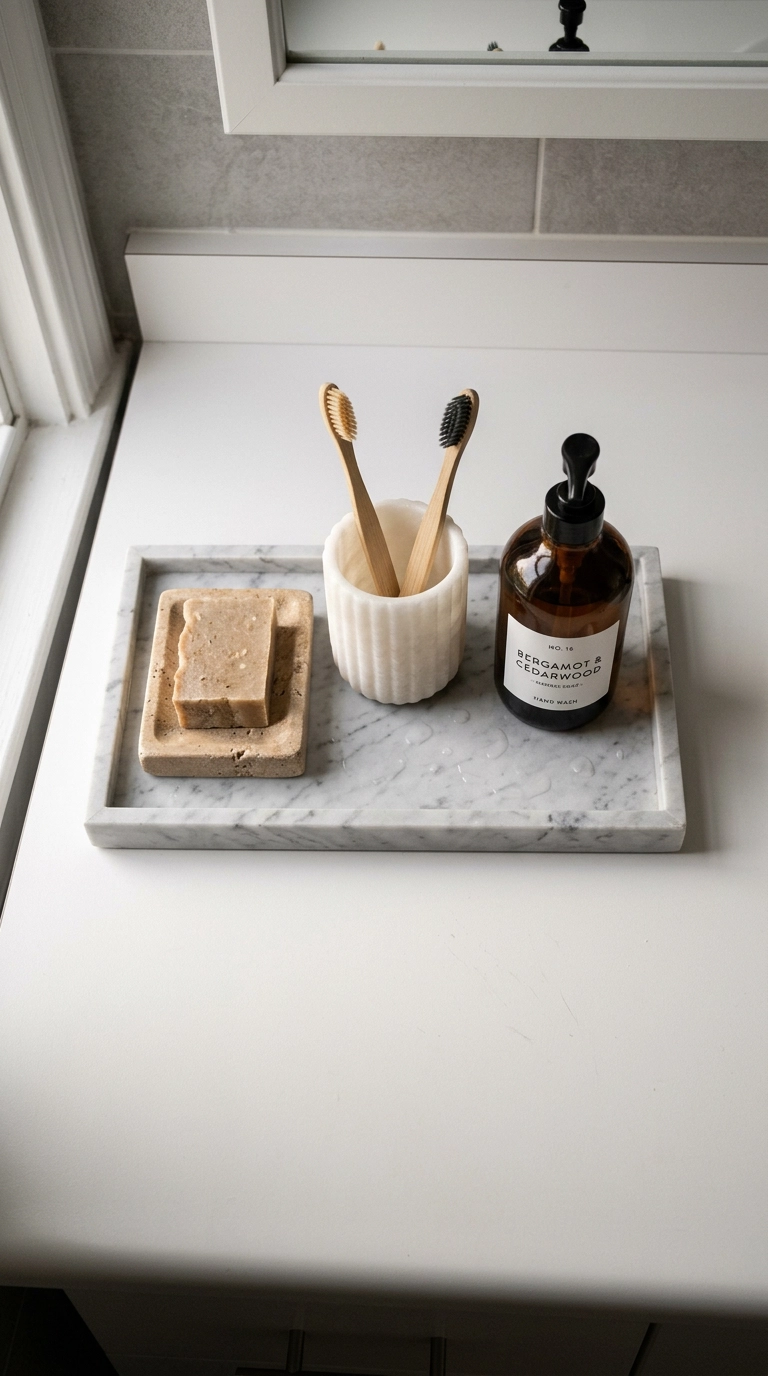
If you rent, this is where you start. A honed marble tray corralling your daily bottles instantly makes a builder-grade laminate counter look styled, and the whole set runs twenty to sixty dollars at any home goods store.
13. Waterfall Stone Vanity with the Slab Running Down the Side
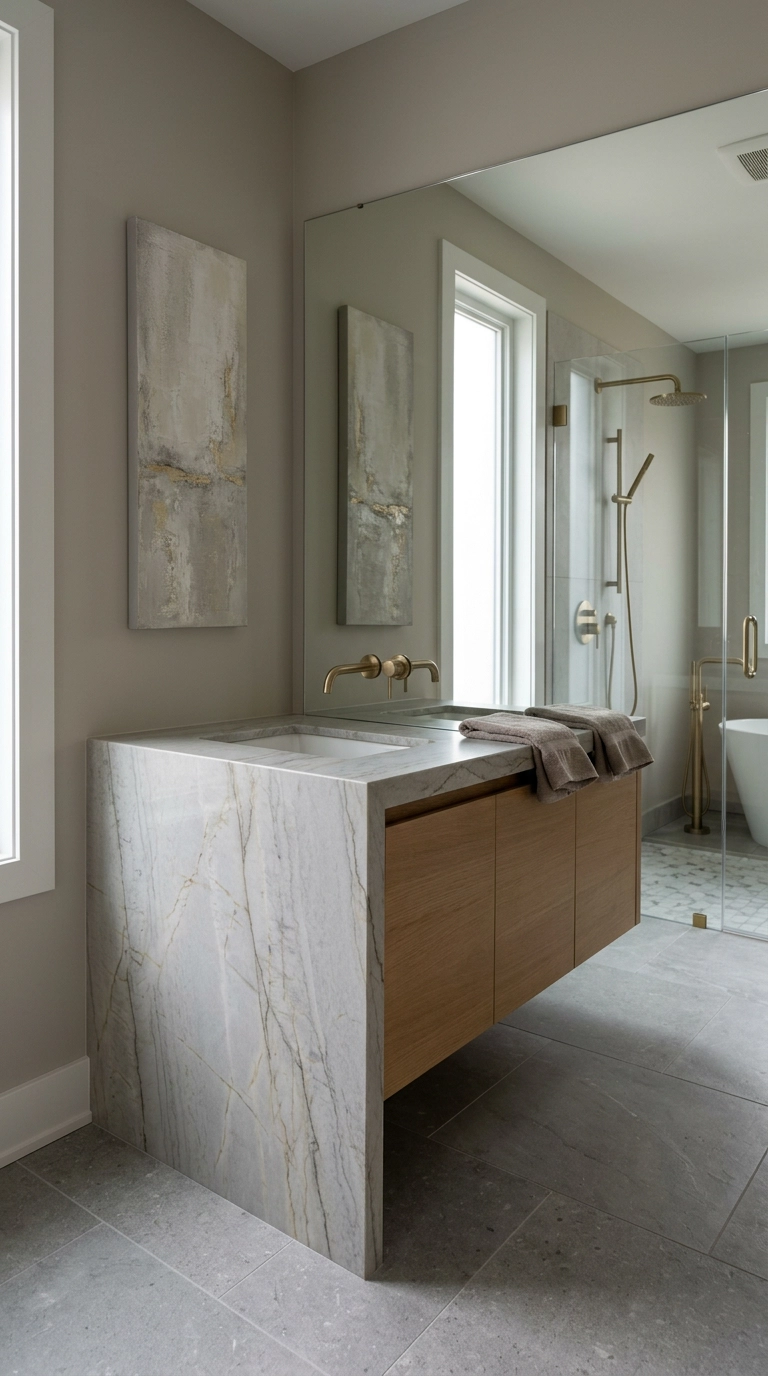
A waterfall edge – where the countertop slab turns 90 degrees and runs to the floor – is the detail that separates a designer bathroom from a stone shop order. It gives the vanity visual weight, meaning it looks anchored and substantial instead of like a shelf stuck on the wall.
14. Stone Mosaic Floor in a Basketweave or Penny Pattern
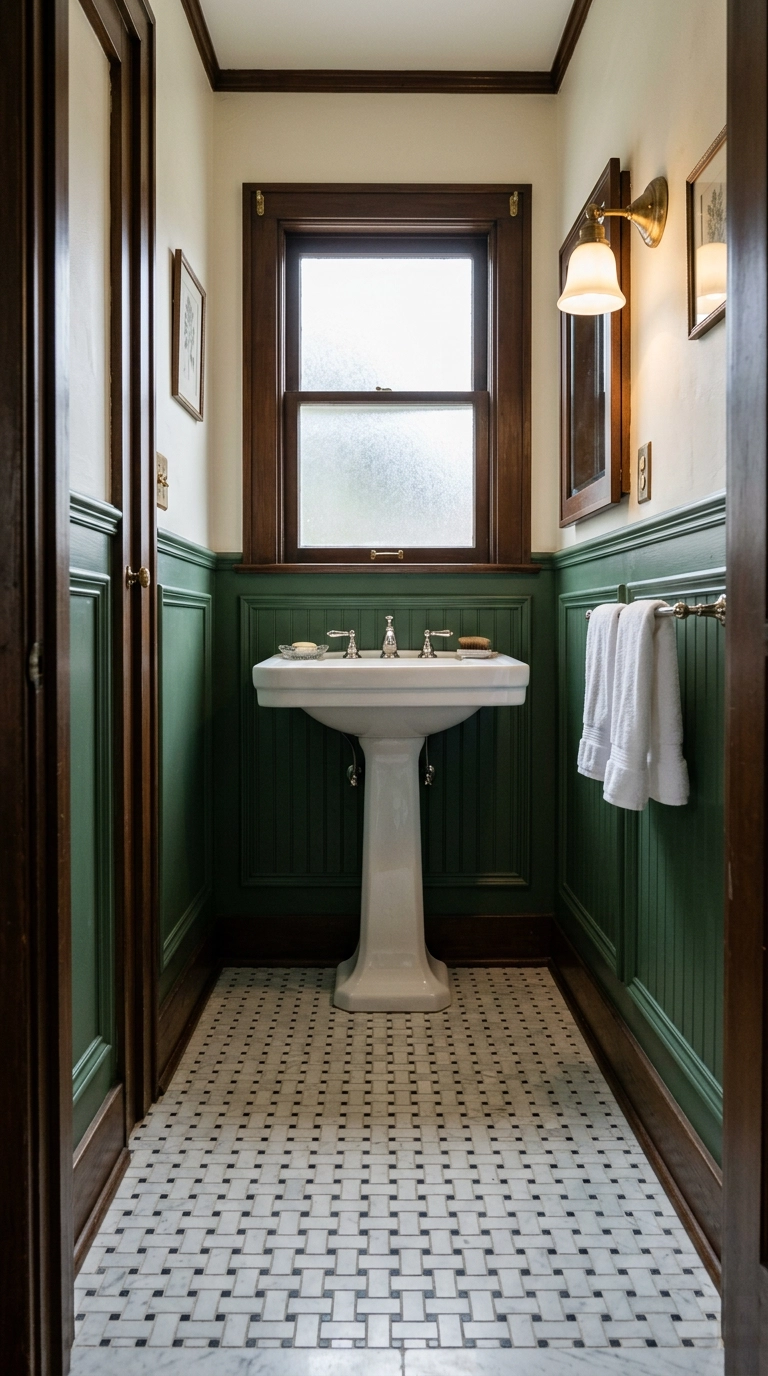
Small stone mosaics are how you get real marble underfoot without a slab budget, because mosaic sheets use offcuts. Basketweave, penny round, and hex all read period-correct in an older American home, and they hide the small floor cuts that a bathroom’s odd geometry demands.
15. A Solid Stone Trough Sink for a Shared Bathroom
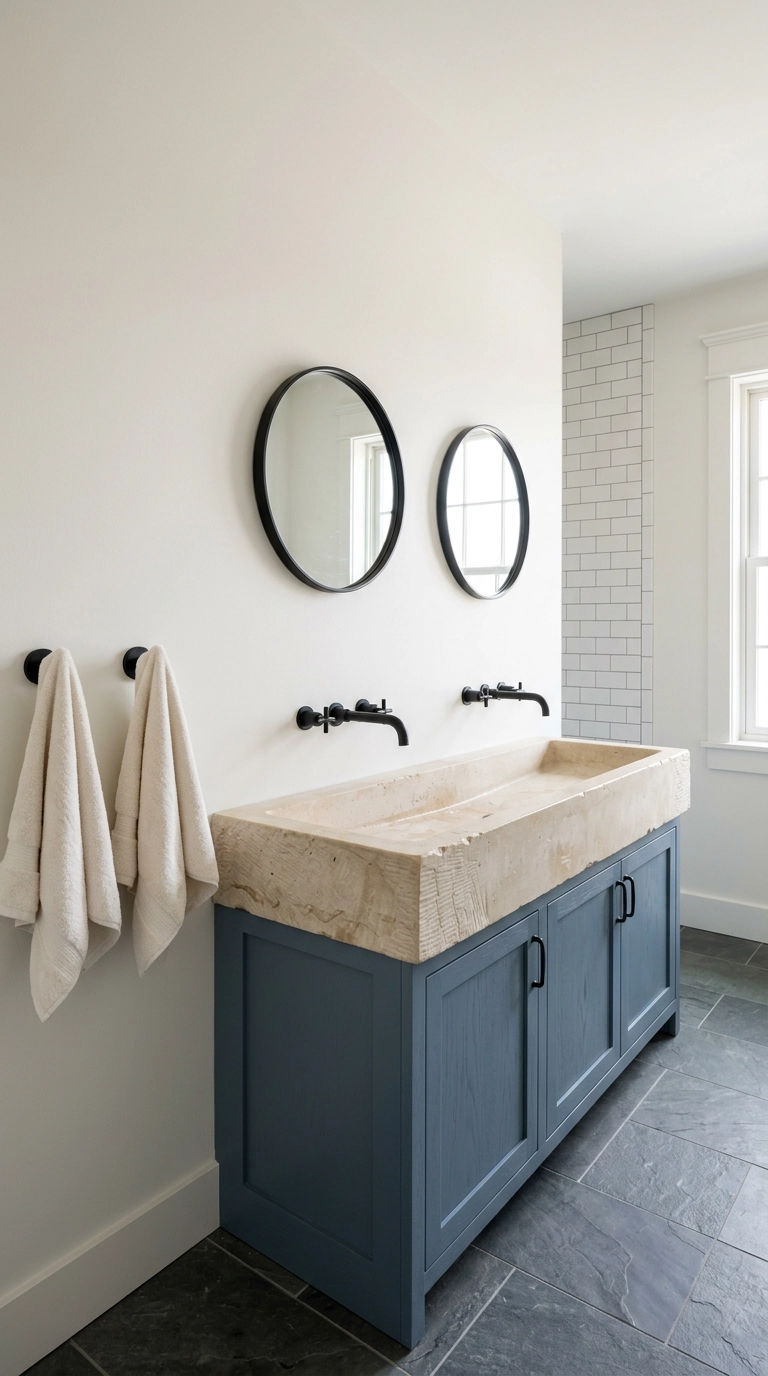
A carved stone trough solves the two-kids-one-sink problem more gracefully than a double vanity, and it takes up less depth. The thick apron front gives you all the visual weight of a slab without needing a big counter.
16. Split-Face Travertine Feature Wall Behind a Freestanding Tub
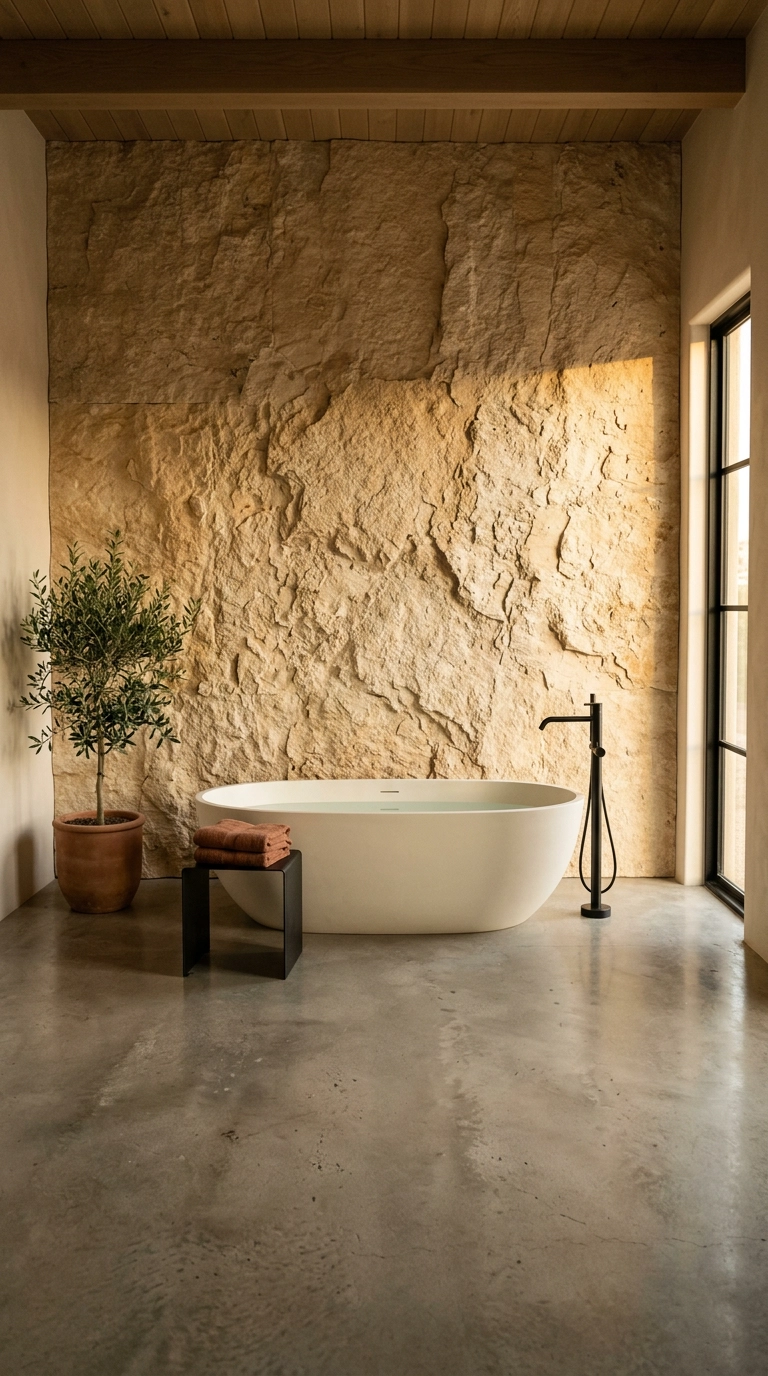
Split-face travertine is stone that’s been cracked rather than sawn, so the surface is genuinely three-dimensional and it changes completely as the light moves across it during the day. Behind a freestanding tub it does what a headboard does in a bedroom – it gives the object a backdrop so it doesn’t float.
17. Honed Marble Shower Niche as a Jewel Box Detail
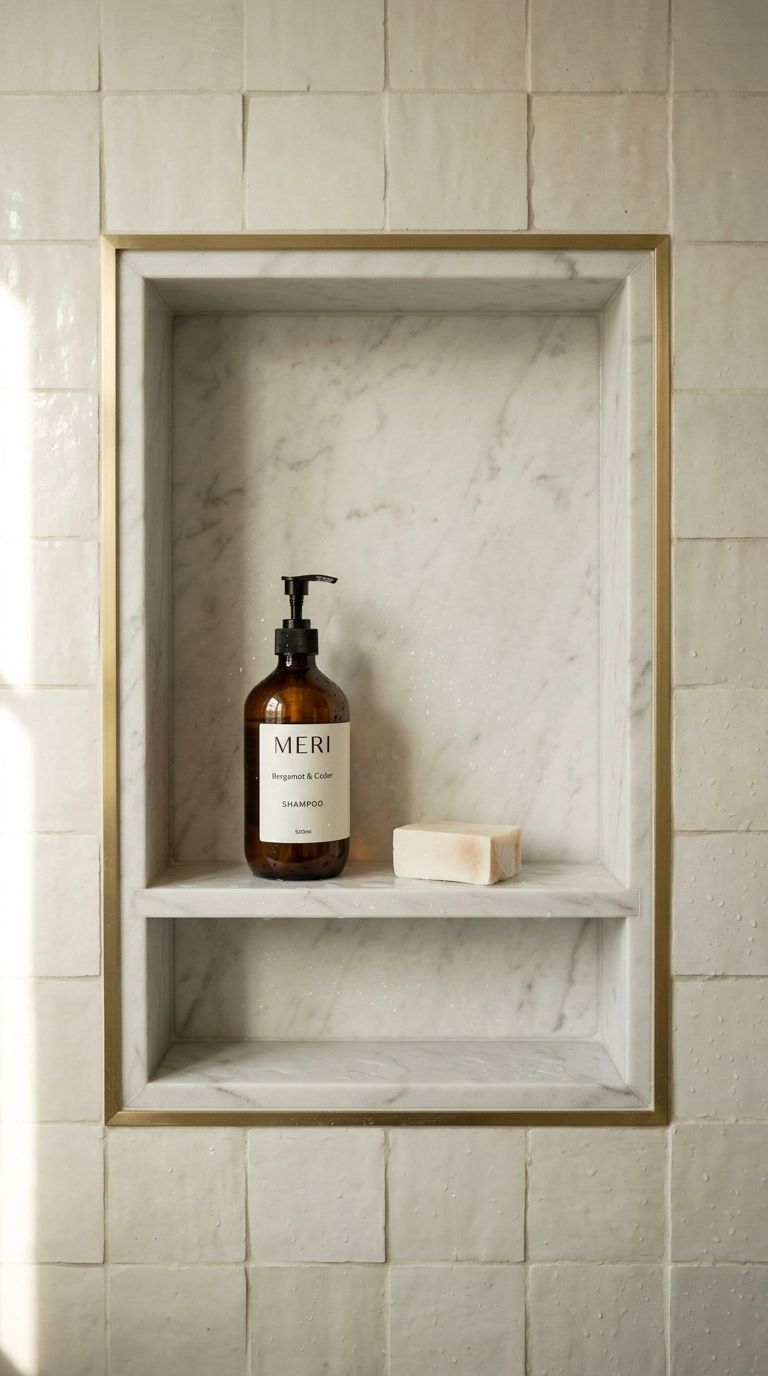
Lining a shower niche in a single piece of marble is my favorite low-cost, high-return stone move. It uses a remnant, it’s usually under a couple hundred dollars in material, and it’s the one spot in a shower where you look closely every single day.
18. Terrazzo: Stone Chips Suspended in Something Tougher
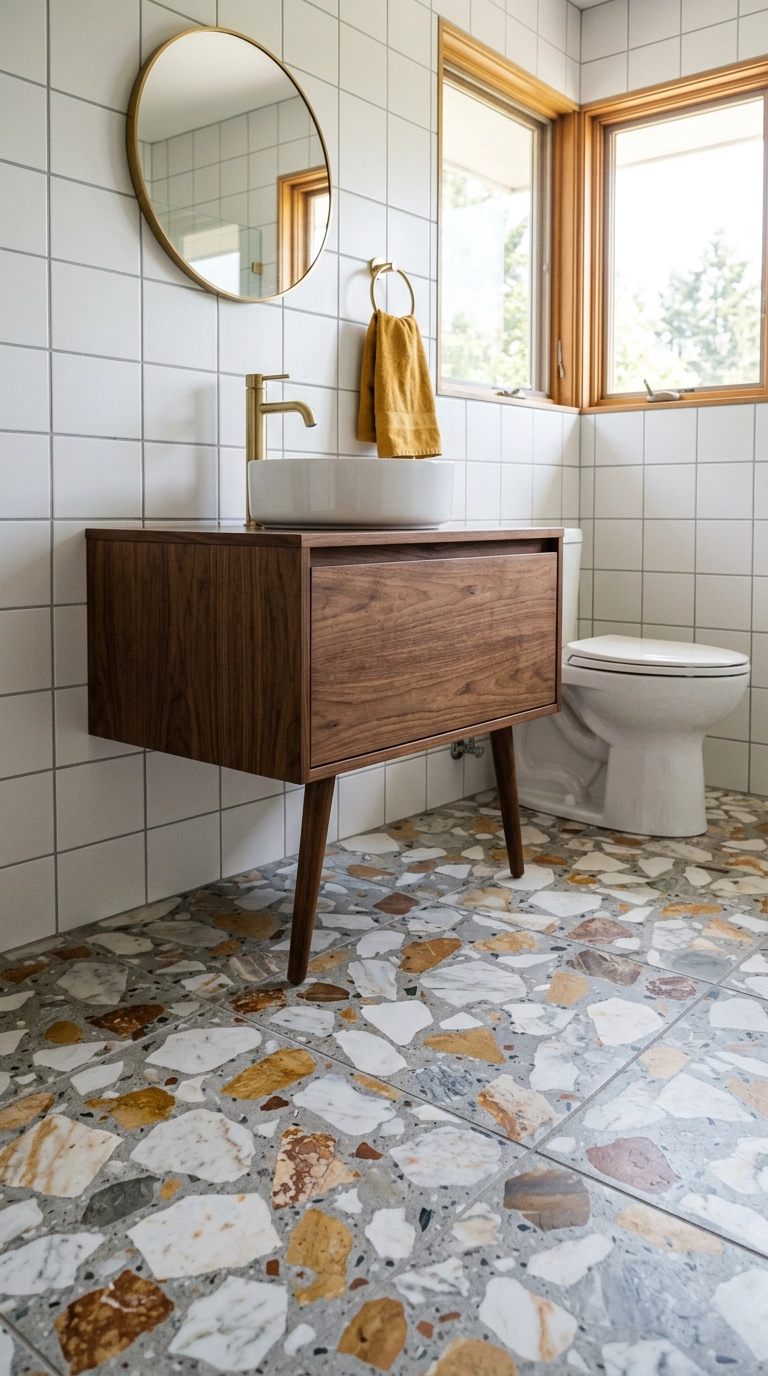
Terrazzo is real marble and granite chips bound in cement or resin, so you get genuine stone character in a surface that’s far harder and less fussy than a slab. It’s also the one stone-family option that can be genuinely playful without looking novelty.
19. Color-Drenched Walls Matched to a Warm Stone Floor
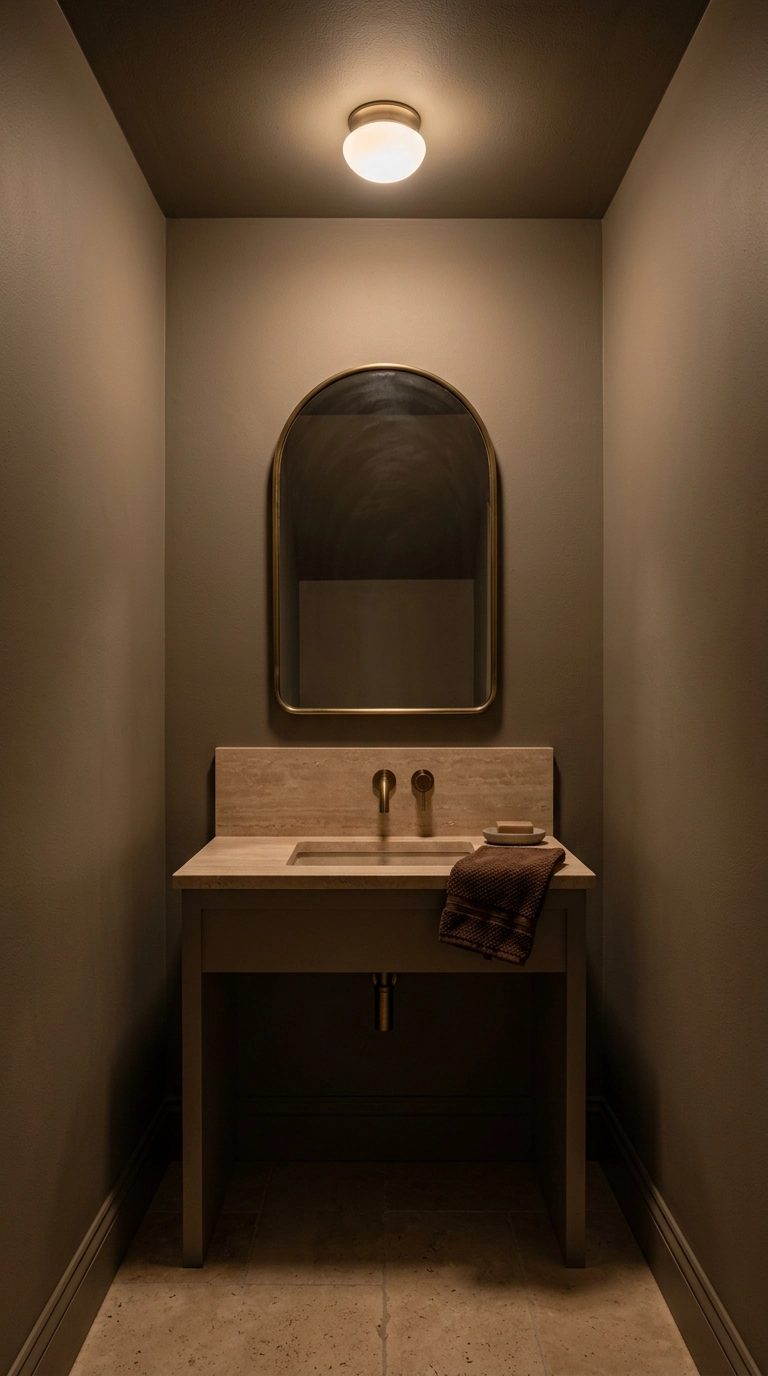
Color drenching means painting walls, trim, and ceiling the same shade, and pulling that shade directly out of your stone floor is the trick that makes a tiny bathroom feel deliberate rather than dark. Erasing the trim line removes the visual break that tells your eye where the room ends.
20. Bookmatched Stone Behind a Wall-Hung Toilet
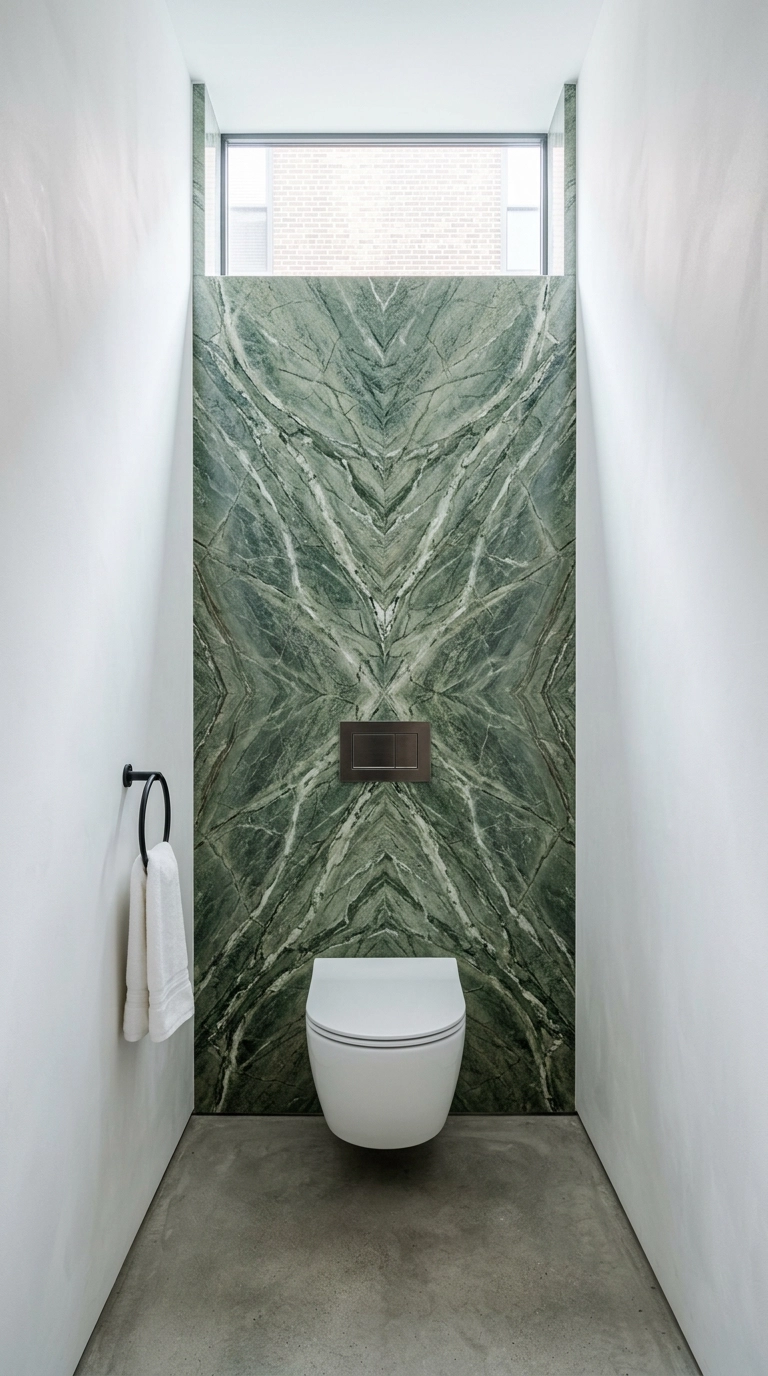
Bookmatching means two slabs cut from the same block and flipped so the veining mirrors like an open book, and the resulting near-symmetry reads as almost intentional artwork. Putting it behind a wall-hung toilet is a genuinely underused move because that wall is otherwise the dead zone of the room.
21. Stone Bath Mat and Diatomite Accessories Instead of Cloth
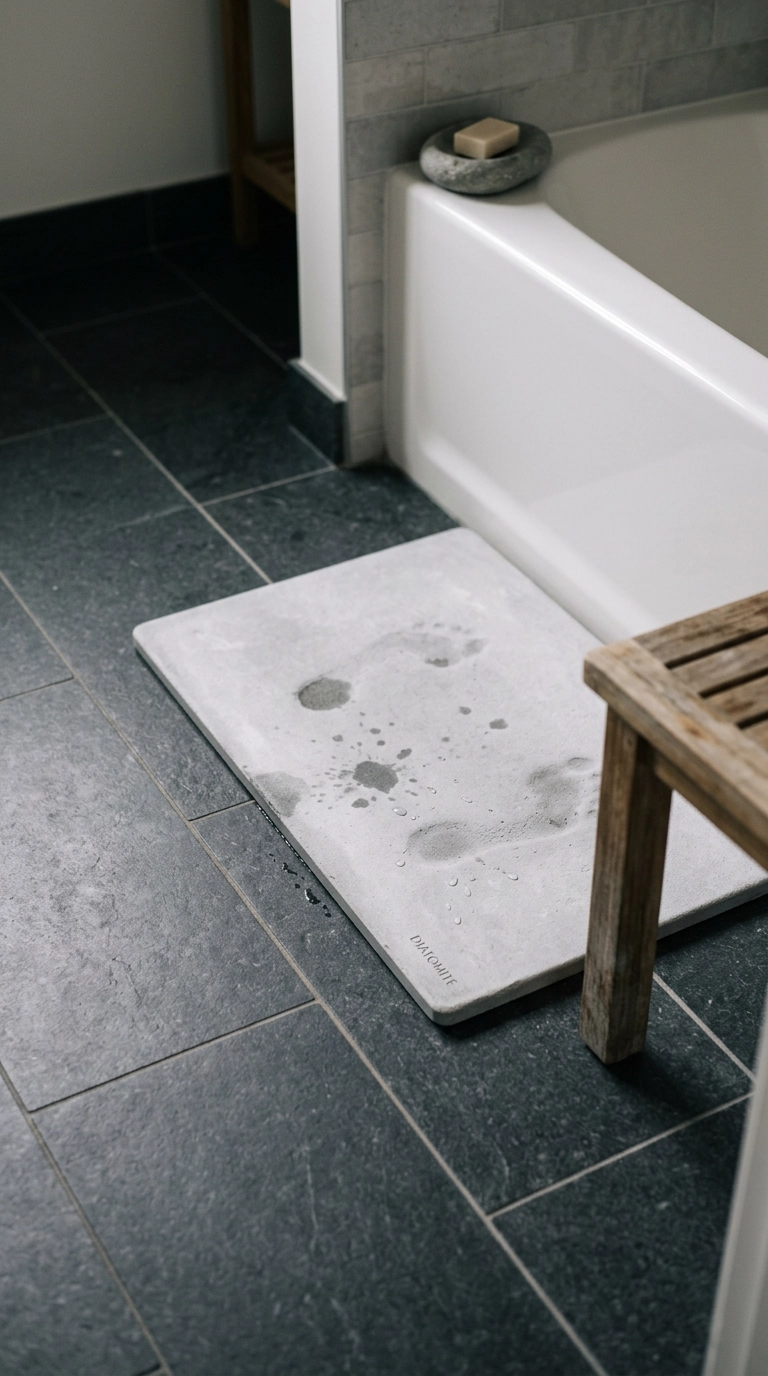
A diatomite stone bath mat absorbs water instantly and dries in minutes, which means no damp cloth mat living on your floor breeding mildew. They run twenty-five to fifty dollars, need zero installation, and are the single easiest way to get stone into a rental bathroom.
22. A Sunken Stone Tub Alcove Wrapped in a Single Material
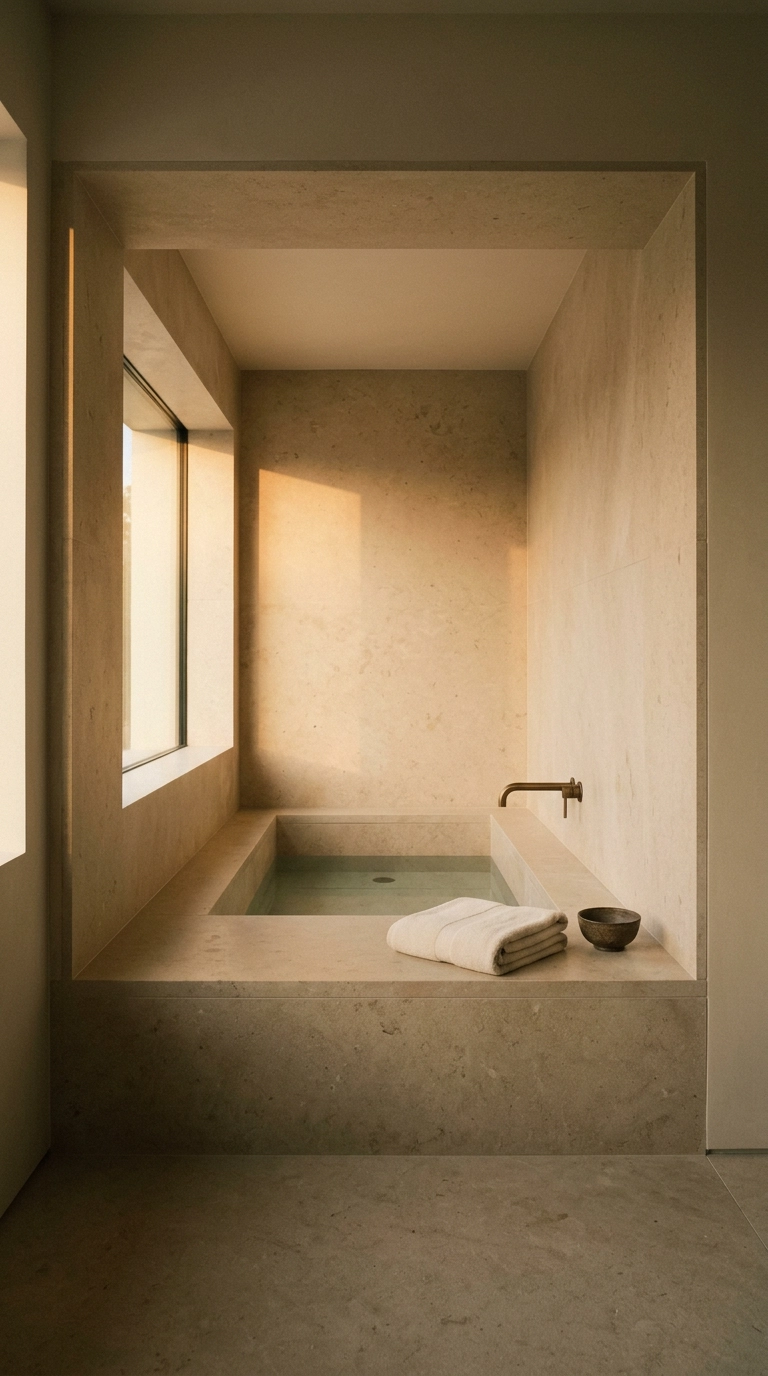
This is the big one, the idea I’d build if the budget were mine: one stone, wrapped continuously across floor, platform, tub surround, and wall, so the alcove reads as a single carved volume. Removing every material change is what makes a bathroom feel like a spa instead of a room with spa products in it.
Living With Stone, Honestly
If you take one thing from this list, let it be that stone in a bathroom is a relationship, not a purchase. Honed marble and travertine will patina and etch, and the people who love their marble bathrooms are the ones who decided early that a soft, worn surface is beautiful rather than damaged. If that idea makes you twitch, slate, soapstone, quartzite, and stone-look porcelain are waiting, and none of them will ever ask you for a bottle of sealer.
What I’m seeing most in 2026 is the shift away from cold grey marble toward warm stone – travertine, honeyed limestone, and green marble like Verde Alpi are everywhere, and the monolithic wrapped-alcove look keeps showing up in every serious project I visit. Kelly Wearstler has been pushing bold veined stone as sculpture for years, and you can see that influence in how designers now treat a slab wall as the art in the room rather than a background. Meanwhile the smartest budget move is still the same one it’s always been: put your real stone where you touch it and see it up close, like a niche, a threshold, or a vanity top, and let large-format porcelain handle the square footage.
My personal favorites from this list are the marble shower niche because it costs almost nothing and delights me daily, the soapstone powder room because it’s genuinely maintenance-free, and the pebble shower floor because it’s the only decor decision that feels good under bare feet. Start with one of those, live with it for a season, and see whether you’re a stone person before you commit a whole room. If you want more real-world material breakdowns like this one, come join my weekly newsletter – I send one honest, practical design note every week, no fluff and no sponsored nonsense, and I’d love to have you there.


